The UG-Flex Project has been working to deliver four key requirements articulated by stakeholders back in 2009.
These were:
1. Systems and processes designed around student need
2. Better support solutions for programme validation and review
3. Trusted, high quality course information
4. Better communication channels
See below for feedback from some of our stakeholders commenting on the impact they think the project has had:
View from a school manager
View from strategic academic planning perspective
View from member of project steering group
Monday, 10 October 2011


Wednesday, 14 September 2011
Comments sought on options for Greenwich's academic calendar post 2012
My thanks to members of the University of Greenwich Teaching Fellows Group for inviting me to give a short presentation today on the research the UG-Flex project has conducted so far into options for Greenwich's academic calendar post 2012.
I've posted up a copy of the "work in progress" diagrams and statement of requirements on this blog and welcome any additional comments and observations. Your input really will help inform the content of the paper that will appear on our new VC's desk on the 1st October.
Claire Eustance
UG-Flex Project Manager
c.eustance@gre.ac.uk x8918
I've posted up a copy of the "work in progress" diagrams and statement of requirements on this blog and welcome any additional comments and observations. Your input really will help inform the content of the paper that will appear on our new VC's desk on the 1st October.
Claire Eustance
UG-Flex Project Manager
c.eustance@gre.ac.uk x8918
Wednesday, 3 August 2011
UG-Flex at the CAMEL on Wheels in Cambridge
Last week's CAMEL meeting in Cambridge marked the start of the final year of the UG-Flex project.
Appropriately the focus was on: sustainability - evaluation - dissemination
Thank you to Amayas and his colleagues at CARET in Cambridge for a fantastic CAMEL.
The cycle tour and supper at Christ's College were an added bonus, not withstanding my rather sore derriere the next day!
I have heard rumours that video clips have been posted on You Tube (Search: dcb09 Cambridge camel).
Appropriately the focus was on: sustainability - evaluation - dissemination
The activities over the two days were extremely useful. As always it was an opportunity to reflect and share progress and challenges and added to this, there was a timely opportunity to reflect on strategies for embedding and sustaining outputs and outcomes. I found this session an (unusually) reassuring indication that because UG-Flex has tackled problems from an institutional perspective and sought solutions that are equally as institutionally grounded and mainstream, this has ensured sustainability has been integral from the outset. While embedding and sustaining change is always a challenge, for UG-Flex at least it is not an overwhelming one.
The session on evaluation was equally useful in clarifying impact and benefits in relation to different stakeholder groups. It reinforced that UG-Flex's decision to focus on targeted training and awareness raising activities in the final 12 months is appropriate.
The final session on "the book" - our vision [increasingly likely I hope to become a reality] for writing up what we have learned on curriculum design / institutional change - rounded off a productive 2 days.
Thank you to Amayas and his colleagues at CARET in Cambridge for a fantastic CAMEL.
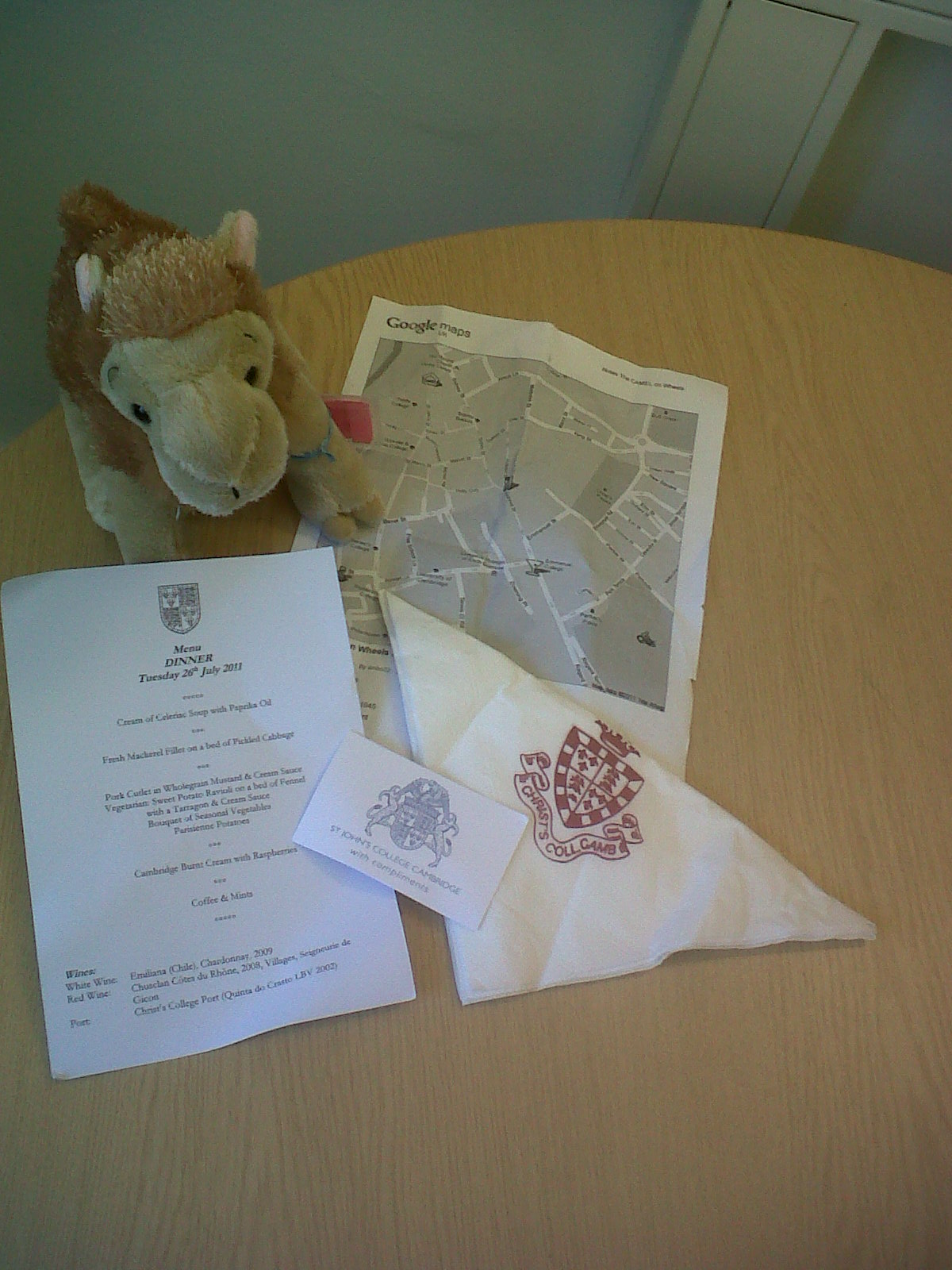
The cycle tour and supper at Christ's College were an added bonus, not withstanding my rather sore derriere the next day!
I have heard rumours that video clips have been posted on You Tube (Search: dcb09 Cambridge camel).
Thursday, 30 June 2011
Blended Learning Conference
A few weeks ago UG-Flex was at the International Blended Learning Conference at the University of Hertfordshire. The project manager contributed to a session called "Enhancing the Blended Learning Experience through Flexibility" and described how we had used aspects of Peter Checkland's soft systems methodology to help stakeholders identify to barriers to flexibility at Greenwich through rich pictures.
A report on the session, along with photos of the rich pictures produced by participants can be found on the Design Studio:
http://jiscdesignstudio.pbworks.com/w/page/41879113/Flexible-learning-rich-pictures
A report on the session, along with photos of the rich pictures produced by participants can be found on the Design Studio:
http://jiscdesignstudio.pbworks.com/w/page/41879113/Flexible-learning-rich-pictures
The Design Studio - a useful resource for curriculum design
The Design Studio is a developing toolkit which draws together a range of existing and emergent resources around curriculum design and delivery and the role technology plays in supporting these processes and practices.
The Studio will provide access to project outcomes and outputs from UG-Flex and other projects in the JISC Curriculum Design and Delivery programmes as they are developed and will continue to be sustained as a community resource after the programmes finish.
The Studio will provide access to project outcomes and outputs from UG-Flex and other projects in the JISC Curriculum Design and Delivery programmes as they are developed and will continue to be sustained as a community resource after the programmes finish.
Disseminating Good Practice & Knowledge Transfer
I am such a fan of the Viewpoint project! There is so much potential in the methodology they have developed to support curriculum teams to review their courses/programmes.
UG-Flex has been working with colleagues in Greenwich's Educational Development Unit (EDU) to help them to build the Viewpoints materials into their work with teams who are embarking on a programme review.
The beauty of Viewpoints is that the materials guide the discussions expose issues and questions. This means programme teams don't feel they are being lectured to and facilitators aren't overburdened with expectations.
On Monday 6th June six members of Greenwich's EDU team travelled over the City University (our extremely generous hosts) to join with colleagues there to take part in a train the trainer session run by Alan Masson and Catherine O'Donnell (our extremely generous and knowledgeable trainers) who had travelled over especially from the University of Ulster.
As well as a hands-on taster session using the Viewpoints materials, Alan and Catherine circulated a comprehensive Viewpoints Handbook and provided lots of advice and handy hints.
![]()
Alan's presentation can be viewed on their slideshare site and photographs of the outputs can be viewed on flickr.
The Handbook and all of the curriculum design resources are available to download free of charge at http://viewpoints.ulster.ac.uk/resources
I think I can safely say that my colleagues in EDU are now adopters (maybe even fans) of Viewpoints. I got some great feedback afterwards and I look forward to seeing the plans for school-based activities and incorporation in Greenwich's teacher training courses put into practice.
UG-Flex has been working with colleagues in Greenwich's Educational Development Unit (EDU) to help them to build the Viewpoints materials into their work with teams who are embarking on a programme review.
The beauty of Viewpoints is that the materials guide the discussions expose issues and questions. This means programme teams don't feel they are being lectured to and facilitators aren't overburdened with expectations.
On Monday 6th June six members of Greenwich's EDU team travelled over the City University (our extremely generous hosts) to join with colleagues there to take part in a train the trainer session run by Alan Masson and Catherine O'Donnell (our extremely generous and knowledgeable trainers) who had travelled over especially from the University of Ulster.
As well as a hands-on taster session using the Viewpoints materials, Alan and Catherine circulated a comprehensive Viewpoints Handbook and provided lots of advice and handy hints.

Alan's presentation can be viewed on their slideshare site and photographs of the outputs can be viewed on flickr.
The Handbook and all of the curriculum design resources are available to download free of charge at http://viewpoints.ulster.ac.uk/resources
I think I can safely say that my colleagues in EDU are now adopters (maybe even fans) of Viewpoints. I got some great feedback afterwards and I look forward to seeing the plans for school-based activities and incorporation in Greenwich's teacher training courses put into practice.
Wednesday, 25 May 2011
Going beyond the obvious – talking about challenge and change (Programme Meeting 11 May 2011)
The JISC Curriculum Design Programme Meetings have become something of a milestone for the UG-Flex project. The recent trip to Birmingham for the latest meeting provided an opportunity for reflection on our project in the context of challenge and change. The question that framed the day was how can we convey, in a useful context, what we have learned and what has changed at Greenwich to others?
![]()
One thing that emerged from the activities and sessions was that UG-Flex is one of the projects that has delivered (and continues to deliver) a combination of technical outputs and softer change outcomes. So in our case we need to think about what outputs and outcomes such as “better dialogue around flexibility and curriculum design and delivery” actually look like and how to describe them to different audiences? Equally how can we convey meaningfully what improved processes and systems around course information / data look like and what impact they have had? To ensure we capture the breadth of what UG-Flex has achieved, it is likely that our approach will encompass case studies as well as multimedia tools and written guides and training.
The meeting was also a chance to talk to colleagues from other projects about their respective approaches to evaluation. These discussions were extremely useful in helping UG-Flex to re-evaluate its own approach, and proved the argument that there is something positive to take from every situation! A paper on our evaluation approach for the remainder of the project will go to the next Project Management Group meeting.

One thing that emerged from the activities and sessions was that UG-Flex is one of the projects that has delivered (and continues to deliver) a combination of technical outputs and softer change outcomes. So in our case we need to think about what outputs and outcomes such as “better dialogue around flexibility and curriculum design and delivery” actually look like and how to describe them to different audiences? Equally how can we convey meaningfully what improved processes and systems around course information / data look like and what impact they have had? To ensure we capture the breadth of what UG-Flex has achieved, it is likely that our approach will encompass case studies as well as multimedia tools and written guides and training.
The meeting was also a chance to talk to colleagues from other projects about their respective approaches to evaluation. These discussions were extremely useful in helping UG-Flex to re-evaluate its own approach, and proved the argument that there is something positive to take from every situation! A paper on our evaluation approach for the remainder of the project will go to the next Project Management Group meeting.
Subscribe to:
Posts (Atom)

